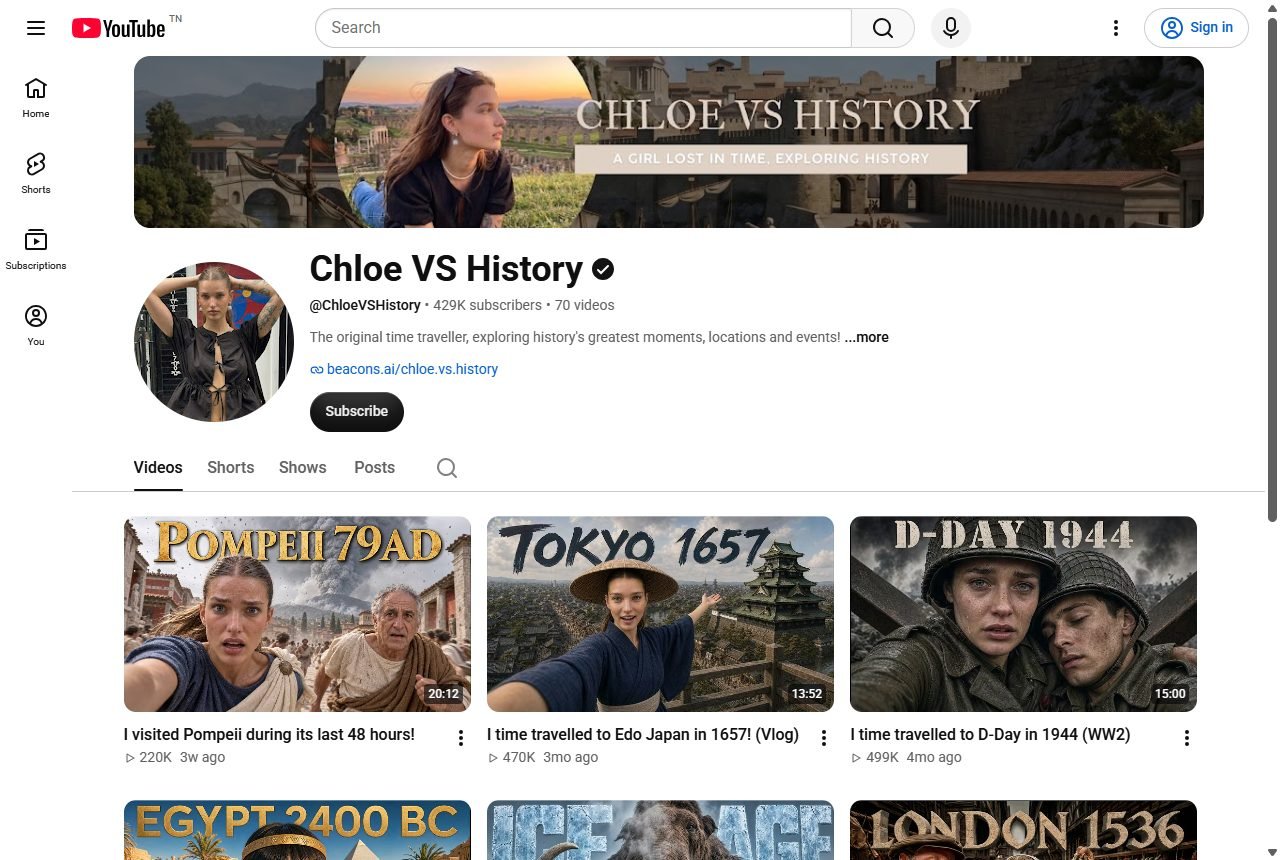
Can you really build a faceless YouTube channel with AI in 2026? Jonathan Laramy did. He never shows his own face. An AI-made host called Chloe “time travels” to the Titanic, Tudor London and Pompeii, and his channel Chloe VS History had 429K subscribers and 32.9 million views when we checked it on 19 Nov 2026. The catch is big. He says one long video costs £300 to £800 and takes weeks, and his short clips earned almost nothing at first.
Prefer to watch? Here is our 4-minute video of this story.

Video by SoftHubTools.
Short answer
Yes, a faceless channel made with AI can grow and earn, but not on autopilot. Jonathan Laramy left a customer service job in June 2025, built an AI history channel, and says it now pays “way more” than that job, according to his Business Insider essay (18 Jun 2026). It worked only after he switched to 15 to 20 minute videos with heavy human checking. YouTube refuses to pay for mass-made, template-like AI videos.
Who is Jonathan Laramy? (work facts only)
- Name: Jonathan Laramy
- Role: AI video creator; described as a UK social media strategist by Yahoo (30 Apr 2026)
- Country: United Kingdom
- Known for: Chloe VS History, a vlog-style history channel hosted by an AI character
- Tools he named: Claude, PAI 2 (Utopai Studios), Nano Banana Pro, ChatGPT, Seedance 2.0 and an AI voice model
- Public channels: YouTube, TikTok, Instagram
- Note: he has no link to SoftHubTools and does not endorse any tool on this page.
Before you copy this method: what you need.
- Skills: writing a short script, checking facts, and doing a simple edit. Laramy had no film training, so you do not need it either.
- Time: he says one long video takes “weeks”. Plan 8 to 10 hours for your first short video on the free path below.
- Money: $0 to start with free tools. His own level was £300 to £800 per long video, so treat that as a later stage, not day one.
New to AI video? Read our free guide how to make AI videos for YouTube first.
Disclosure: some links below (ElevenLabs, HeyGen, Synthesia, Pictory, Filmora) are affiliate links. If you buy, we may earn a commission at no extra cost to you. Jonathan Laramy did not use these tools as far as his public sources show; the one example that did use ElevenLabs is Kapwing’s test, explained below. We list free options first. See how we pick tools on our recommended tools page.
Your two options: copy the method free, or take a tool shortcut
Option 1 is the free method in the steps below. Option 2 is a paid tool for each part of the channel: voice, pictures, edit. Prices checked on the official pages on 19 Nov 2026; ElevenLabs and Pictory rechecked on 24 Nov 2026.
- Voice: ElevenLabs. Natural AI narration. Free plan: 10,000 credits a month (about 10 minutes), with no commercial license. Starter adds the commercial license for $6/month (checked again on 24 Nov 2026). Try ElevenLabs · our ElevenLabs guide
- Visuals with a presenter: HeyGen. An AI host reads your script, a bit like Chloe. Free: 3 watermarked videos a month, up to 1 minute. Creator: $29/month, or $24/month billed yearly. Try HeyGen · HeyGen vs Synthesia
- Visuals for explainers: Synthesia. Presenter videos in many languages. Free: 10 minutes a month with a watermark. Starter: $19/month, or $14/month billed yearly. Try Synthesia
- Script to stock video: Pictory. Turns a script into scenes with captions and a voice. Free trial available. Starter: $29/month billed monthly, or $12.50/month billed yearly in the Black Friday sale (rechecked 24 Nov 2026; the sale ends 2 Dec 2026). Try Pictory · our Pictory review
- Editing: Filmora. A simple desktop editor. The free version adds a watermark on export. Advanced: $59.99/year. Try Filmora. Free options: CapCut or DaVinci Resolve.
Our opinion: start with the free path and your own voice or the ElevenLabs free plan. Pay for ElevenLabs Starter first, because a clear voice matters on every video. See ElevenLabs plans and try the free plan (affiliate link). Add HeyGen only if you want a recurring host like Chloe.
Be careful: no tool makes a channel “passive”. YouTube does not pay for AI videos that look mass-produced from a template, so your own idea, research and final check still decide everything.
In this post
- Who is Jonathan Laramy?
- Your two options
- Timeline: from customer service to 429K subscribers
- The starting point
- The tools he named, and what each one does
- The turning point: longer videos
- Results, as reported
- What did not work
- A second example: Kapwing’s ElevenLabs test
- YouTube’s rules for AI and faceless channels
- How a beginner can copy the method
- Faceless YouTube channel with AI: ideas based on what worked
- Who should not start a faceless channel
- FAQ: questions beginners ask about faceless AI channels
Timeline: from customer service to 429K subscribers
Every date below comes from a public source. Click the source to check it yourself.
| Date | What happened | Source |
|---|---|---|
| June 2025 | Quits his customer service job to work on AI video | Business Insider, 18 Jun 2026 |
| 4 Aug 2025 | The Chloe VS History YouTube channel is created | Channel “About” page (checked 19 Nov 2026) |
| 23 Mar 2026 | Sky News tracks down the creator and names the video model, Seedance 2.0 | Sky News video, 23 Mar 2026 |
| 23 Mar 2026 | “Ancient Rome” vlog goes up: 1,616,671 views by 19 Nov | YouTube video page |
| 14 Apr 2026 | “Titanic 1912” vlog: 3,221,622 views by 19 Nov | YouTube video page |
| 30 Apr 2026 | Press reports that “Chloe” is an AI persona made by a UK creator | Yahoo, 30 Apr 2026 |
| 15 May 2026 | “Tudor London 1536” vlog: 3,055,860 views by 19 Nov | YouTube video page |
| 23 May 2026 | A history blogger lists accuracy errors in the videos | Fake History Hunter, 23 May 2026 |
| 18 Jun 2026 | His first-person essay on costs and income is published | Business Insider |
| 25 Oct 2026 | A 20-minute Pompeii vlog: 220,832 views by 19 Nov | YouTube video page |
| 19 Nov 2026 | 429K subscribers, 70 videos, 32,893,588 total views | Channel “About” page (our check) |
The starting point: no film school, one clear idea
Laramy did not start as a video pro. “I had no formal filmmaking background, production training, or experience creating videos professionally,” he wrote, according to Business Insider. He worked in customer service and played with AI in his spare time.
He did have one useful head start, though. In the same essay he says he “already had successful social media channels about history”. So he knew his topic and his audience before AI entered the picture. That detail matters for beginners, because it explains why his videos had a point of view from day one.
His idea was simple to explain. A modern vlogger named Chloe visits famous moments, such as the Titanic’s first voyage or Pompeii before the eruption. “History is a little bit dry in general on YouTube and other places,” he told Fox News, as quoted by Yahoo (30 Apr 2026). He mixed a dry subject with a familiar social media format.
Here is one of his own videos, so you can judge the format yourself. Credit: Chloe VS History (Jonathan Laramy).
Video by Chloe VS History, published 14 Apr 2026. We link to it; we did not copy any frames.
The tools he named, and what each one does
Laramy listed his stack in plain words. He uses Claude “for ideation and general script structure”. Next, he generates images “through PAI 2 (an AI software by Utopai Studios) using Nano Banana Pro and ChatGPT 2.0”. After that, he turns the images into clips “with Seedance 2.0” and uses “an AI voice model” to keep Chloe’s voice the same in every video. All of this comes from his Business Insider essay. Sky News also named Seedance 2.0 in its 23 Mar 2026 report.
Each tool does one job. The middle column below is his stack; the last column is our beginner suggestion, not his.
| Job | What Laramy uses | Beginner option (our pick) |
|---|---|---|
| Idea and script | Claude | Any free chatbot, then check facts in real sources |
| Character and scene images | PAI 2 with Nano Banana Pro and ChatGPT | Nano Banana or Leonardo AI free credits |
| Moving clips | Seedance 2.0 | See our AI video generators list; Pictory for stock-footage explainers |
| Voice | “An AI voice model” (not named) | ElevenLabs free plan (Starter $6/month), or ElevenLabs vs Murf to compare |
| Edit | Post-production (tool not named) | CapCut or DaVinci Resolve free; Filmora paid |
Notice one thing he spent time on. Creating Chloe took only “between five and 10 versions” of the character, he wrote. However, he spent “much more time refining her personality and dialogue”. The face was quick; the personality was the real work.
Want a natural AI voice for your first video? ElevenLabs has a free plan; the $6/month Starter adds the commercial license.
Try ElevenLabs (free plan)Affiliate link: we may earn a commission at no extra cost to you. Jonathan Laramy did not use ElevenLabs as far as his public sources show; we suggest it as a beginner option. Start with the free option first.
The turning point: longer videos
For a long time, the money did not come. “For a long time, I wasn’t making much money from the project,” he wrote in Business Insider. Then he changed format.
He moved to videos of 15 or 20 minutes. Viewers who watched to the end made YouTube recommend his videos more. “The more viewers watched to the end and engaged with my long-form content, the more YouTube recommended my videos,” he explained. The long videos also pushed traffic to his Shorts, which “hadn’t been getting much traction” alone.
His own upload list matches that story. For example, the Titanic vlog runs about 14 minutes, and the Pompeii vlog of 25 Oct 2026 runs about 20 minutes, according to their YouTube pages on 19 Nov 2026.
Results, as reported
We only list numbers that have a public source next to them. Income figures were never published, so we do not guess them.
- Income: “The channel is now earning me way more than my original customer service wage,” according to Business Insider (18 Jun 2026). He gave no amount.
- Subscribers and views: 429K subscribers, 70 videos and 32,893,588 views, according to the channel’s About page, checked by us on 19 Nov 2026.
- Top videos: Titanic 3,221,622 views and Tudor London 3,055,860 views, according to the Titanic page and the Tudor London page on 19 Nov 2026.
- Cost per video: “between £300 and £800 ($400 to $1,070)” for one long video, and “about $3 per 15-second clip”, according to Business Insider.
Also note his own lesson. “Access to AI tools isn’t what separates successful creators from everyone else,” he wrote. The hard part, in his words, is “figuring out what people actually want to watch and then building a process that consistently delivers it.”
What did not work
This is the part most “faceless income” lists leave out. Laramy was open about it.
- Short videos alone: his Shorts did not take off by themselves, as he wrote in Business Insider.
- Other platforms: Instagram “doesn’t pay for views”, and he “wasn’t accepted” into TikTok’s Creator Rewards program, he wrote in the same essay.
- Cost of failure: one video can need “10-15 revisions”, and “those expenses are there whether the video succeeds or not.”
- AI mistakes: AI models add wrong details, “like street lamps and sunglasses in my ancient Rome video,” he wrote. So every scene must be checked.
- Accuracy criticism: a history blogger listed errors, for example a plague-doctor mask in a period before it existed, in a review dated 23 May 2026.
- Trust: the account bio presented Chloe as “just a girl from L.A. lost in history”, and press coverage revealed she is AI, reported Yahoo. Educators quoted there also warned that AI history can carry mistakes and biases.
Be clear with viewers from day one that your host or voice is AI. It costs you nothing, and it protects trust.
A second example: Kapwing’s ElevenLabs test
For balance, here is a smaller, very honest test. Video editor company Kapwing ran a faceless Shorts channel and wrote up the numbers in “We Grew a Faceless YouTube Channel to 1000 Subscribers” by Julia Enthoven (6 Jan 2025). Keep in mind that Kapwing sells a faceless video maker, so it has a business interest.
- Tools: Kapwing’s own script-to-video editor and an ElevenLabs voice called “Adam”.
- Timeline: first video on 17 June 2024; 1,000 subscribers on 21 Nov 2024, which took 157 days.
- Output: 60 videos (58 Shorts) and 1.1 million views in total.
- What worked: one narrow niche (women’s gymnastics) and search-style titles. “Search matters a lot,” the article says.
- What failed: some AI scripts had wrong facts that viewers spotted. YouTube also took the channel down on 3 Oct 2024 for spam or deceptive practices, then restored it within an hour after an appeal.
- Money: it did not reach ad revenue. In the last 90 days it had 37 watch hours and 500K Shorts views, below the bar.
One line from that test answers a common fear: “YouTube watchers do not seem to mind AI voices.” So the voice is rarely the problem. Thin, repeated content is.
A fresh 2026 data point
The slow start is normal. Daniel Nest of the Why Try AI newsletter used ElevenLabs narration for two AI-made Shorts. Both together got 15 YouTube views (and 1,221 viewers on Instagram), he reported on 12 Nov 2026. So never judge a channel by its first week.
YouTube’s rules for AI and faceless channels (checked 19 Nov 2026)
Can an AI voice channel be monetized? Yes, if it follows these official rules. We read each page on 19 Nov 2026.
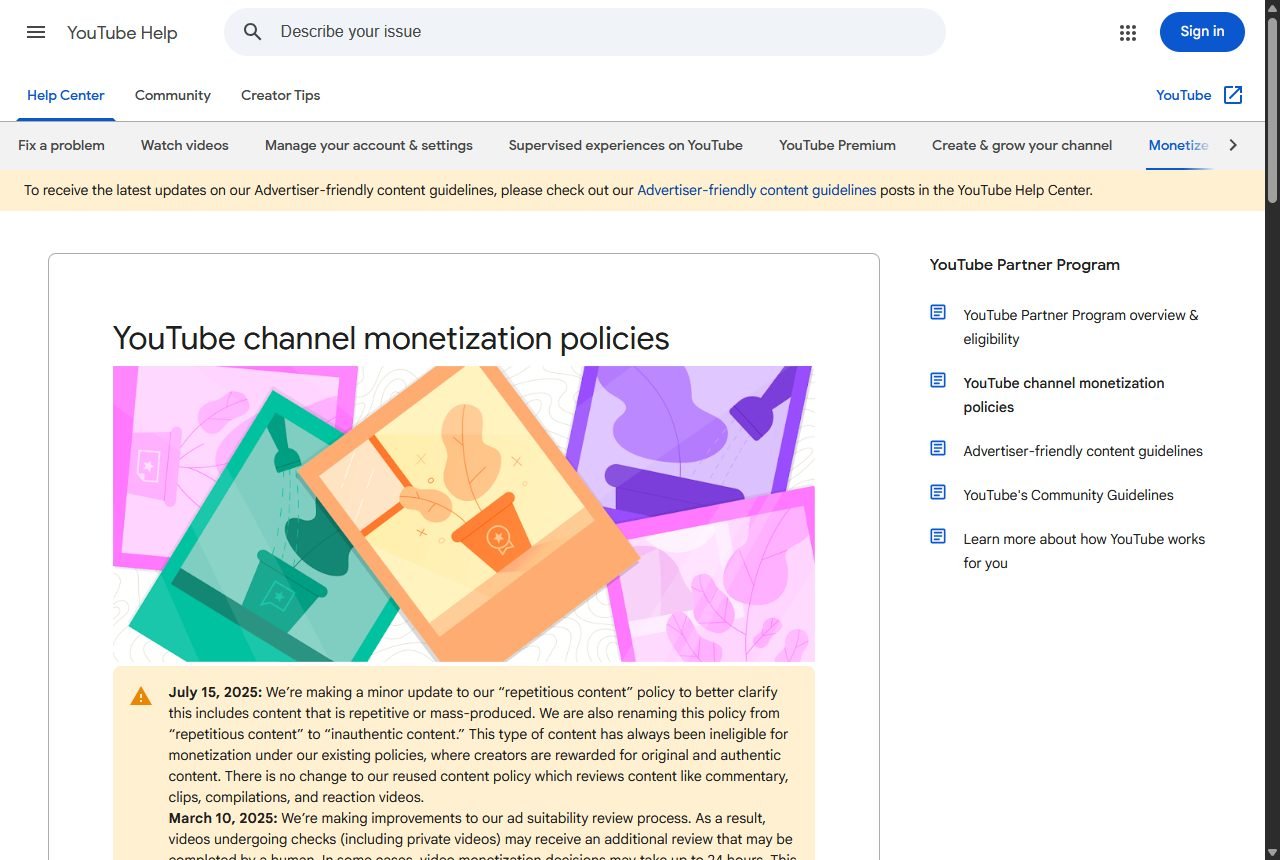
1. “Inauthentic content” (the July 2025 update)
On 15 July 2025, YouTube renamed its “repetitious content” policy to “inauthentic content”, according to the YouTube channel monetization policies page. The same note says this content “has always been ineligible for monetization”. The page gives a direct AI example of what is not allowed: “AI-generated content made with generic or unoriginal templates giving the impression of mass production.”
The spam and deceptive practices policy goes further. It bans “using automated tools or AI to churn out high volumes of similar content with minimal changes.” It even gives the example of channels with each video “reading out an AI-generated script”.
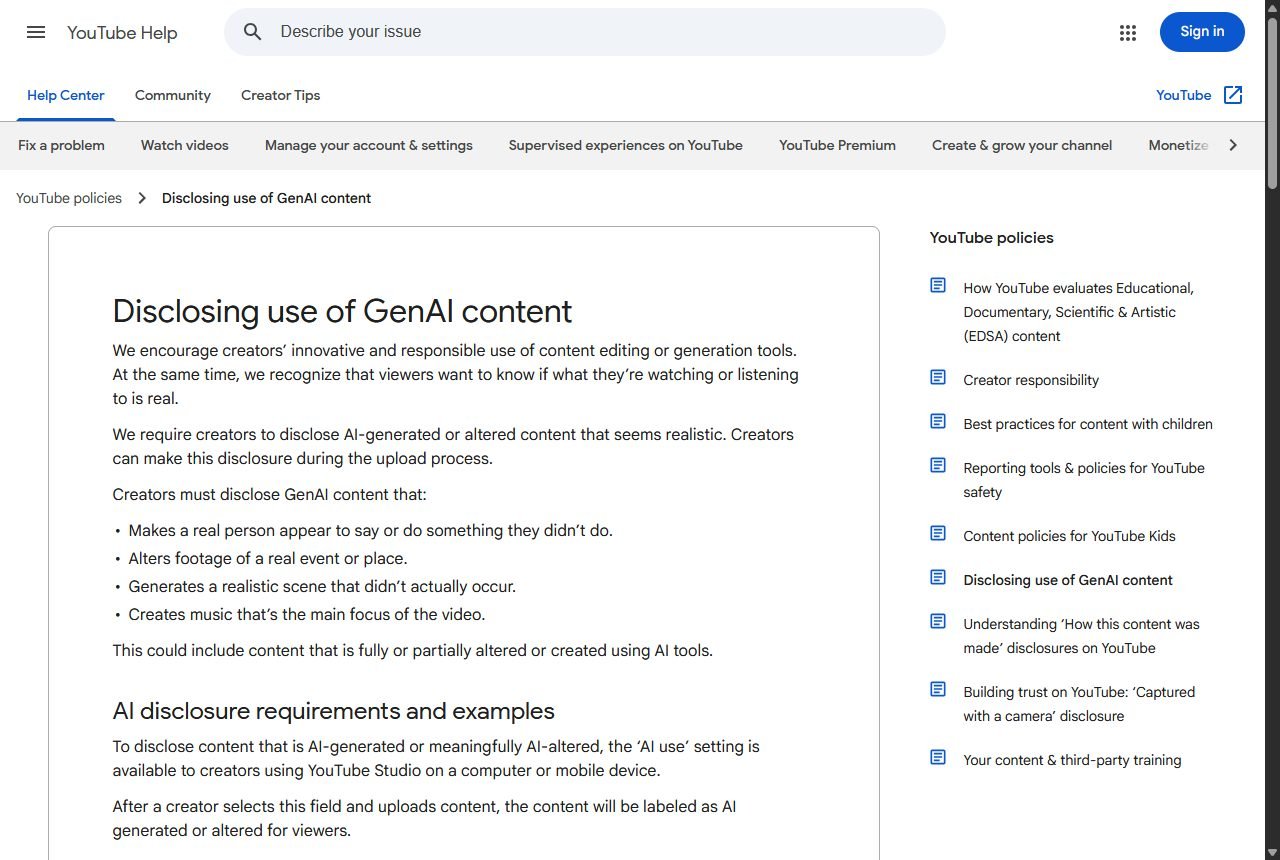
2. The altered or synthetic content label
You must tell YouTube when content is realistic and made or changed with AI, according to the disclosure help page. You do it during upload, in the “AI use” question. Fully animated or clearly unrealistic content does not need it. Good news: “Disclosing AI content alone won’t limit a video’s audience or impact its eligibility to earn money.” Repeated non-disclosure can lead to penalties, including removal from the Partner Program.
3. The bar for ad money
To share ad revenue, you need 1,000 subscribers plus either 4,000 watch hours in 12 months or 10 million Shorts views in 90 days, according to the YouTube Partner Program overview. Even then, a human reviews the channel.
How a beginner can copy the method
You do not need £800 per video. Copy the logic: one strong format, careful checking, then longer videos. These seven steps use free tools first. Times are our estimates for a first 60 to 90 second video.
Step 1: Pick one format and one niche (1 hour, $0)
Write one sentence: “In every video, ___ does ___.” Laramy’s was “a vlogger visits a moment in history.” Kapwing’s was “the hardest routine on ___.” Choose a topic you already know, because you will fact-check it again and again.
Step 2: Write and check the script (2 hours, $0)
Draft with a free chatbot. Then check every fact in a real source, since both Laramy and Kapwing hit AI mistakes. Keep the hook short and put your own opinion in the script.
Step 3: Make the voice (30 minutes, $0 to $6)
The free path is your own voice on a phone. Otherwise, use the ElevenLabs free plan for tests. For a channel you plan to monetize, the free plan has no commercial license, so move to Starter at $6/month (checked 24 Nov 2026). Compare voices in our AI voice cloning tools guide. Open ElevenLabs (affiliate link).
Step 4: Make the visuals (2 to 3 hours, $0)
Make scene images with free credits in Nano Banana or Leonardo AI, then animate a few. Want a host like Chloe without filming? HeyGen’s free plan gives 3 short watermarked videos a month. Try HeyGen (affiliate link), or see our HeyGen step-by-step. For stock-footage explainers, Pictory (affiliate link) is faster.
Step 5: Add music and edit (1 to 2 hours, $0)
Edit in CapCut or DaVinci Resolve for free. Add royalty-free music, or make your own with our Suno guide. If you prefer a simple desktop editor with no watermark, Filmora (affiliate link) costs $59.99/year.
Step 6: Upload honestly (20 minutes, $0)
Answer the “AI use” question in YouTube Studio when the video looks realistic. Use a search-style title, as Kapwing did, and say in the description that the host or voice is AI.
Step 7: Review after 10 videos (1 hour, $0)
Look at average view duration in YouTube Studio. If Shorts stall, try one longer video on your best topic, like Laramy did. Keep the format, but change the story every time, so the channel never looks template-made.
Total for video one: about 8 to 10 hours and $0 on the free path. A small paid setup (ElevenLabs Starter plus a free editor) starts at $6/month. For a fuller walk-through, see how to make AI videos for YouTube.
Our pick: if you pay for only one tool, pay for ElevenLabs Starter; add HeyGen only for a recurring host and Pictory only for stock-footage explainers. Start free, then add ElevenLabs Starter ($6/month, checked 24 Nov 2026) when you want to monetize. Try ElevenLabs (affiliate link). Want a recurring AI host like Chloe? Try HeyGen free (affiliate link).
Want faster script-to-video scenes with captions? Pictory turns a script into stock-footage scenes and has a free trial.
Try Pictory (free trial)Affiliate link: we may earn a commission at no extra cost to you. Jonathan Laramy did not use Pictory as far as his public sources show; we suggest it as a beginner option. Start with the free option first.
Faceless YouTube channel with AI: ideas based on what worked
These ideas follow the patterns from the two real examples above. They are starting points, not income promises.
- A recurring AI host in your niche: the Chloe model, applied to science, cities or sports history.
- Search-answer Shorts: short answers to questions people type, like Kapwing’s “Is Simone Biles injured?” title.
- “A day in…” explainers: one place, one year, told as a story with sources in the description.
- Tool tutorials with an AI voice: screen recordings plus clear narration, a format that also fits our ways to make money with AI guide.
Avoid one idea in particular: reading other people’s posts word for word with an AI voice. That is reused content, and it is the riskiest format under the rules above.
Who should not start a faceless channel
- You want fast, passive income. Laramy says he went a long time without much money, and Kapwing never reached ad revenue.
- You do not want to fact-check. AI errors will reach your viewers and your comments.
- You plan to post many near-identical videos. That is exactly what YouTube calls inauthentic content.
- You cannot spend money that may not come back. Laramy’s costs exist “whether the video succeeds or not.”
Still keen? Then start small, stay honest about AI, and treat the first 10 videos as practice.
FAQ: questions beginners ask about faceless AI channels
Can a faceless channel with an AI voice get monetized?
Yes. YouTube does not ban AI voices; it bans mass-produced, template-like content. Meet the 1,000 subscriber bar plus 4,000 watch hours or 10 million Shorts views, add real ideas and research, and disclose realistic AI.
Do viewers mind AI voices?
Often not. Kapwing’s 2024 test concluded “YouTube watchers do not seem to mind AI voices.” However, a flat, robotic voice or a thin script loses viewers fast, so pick a natural voice and write like a person.
Is YouTube automation still worth it, or is it a scam?
The method is real, but “automation” is the wrong word. Laramy reruns scenes until they look right (10-15 revisions per video) and says one long video takes weeks. Be careful with courses that promise passive income; the real work is ideas, checking and editing.
How much does it cost to start a faceless channel?
You can start at $0 with free tools and your own voice. A basic paid setup starts at $6/month for ElevenLabs Starter (checked 24 Nov 2026). Laramy’s high-end AI videos cost £300 to £800 each.
Can I narrate Reddit stories with an AI voice?
It is risky. Reading posts word for word adds little of your own, which YouTube treats as reused content, and the writers own their stories. If you do it, ask permission and add real commentary.
Sources were read on 19 Nov 2026. We did not test Seedance 2.0 or PAI 2 ourselves, and we have no contact with Jonathan Laramy or Kapwing.
📧 Get the next tested AI tool in your inbox
Free: every new guide we publish (AI video, voice, automation) plus one checked remote AI job each week. No spam, unsubscribe anytime.
Discover more from SoftHubTools
Subscribe to get the latest posts sent to your email.