
⚡ Quick Answer: RAG vs Agentic AI 2026 — Learn and Earn Complete Guide
Specifically, RAG vs Agentic AI defines how businesses deploy intelligent systems in 2026. Moreover, RAG retrieves documents to ground AI answers in real data. Furthermore, Agentic AI takes autonomous multi-step actions to complete complex goals. Consequently, your business needs determine which approach delivers the best ROI.
📖 Table of Contents
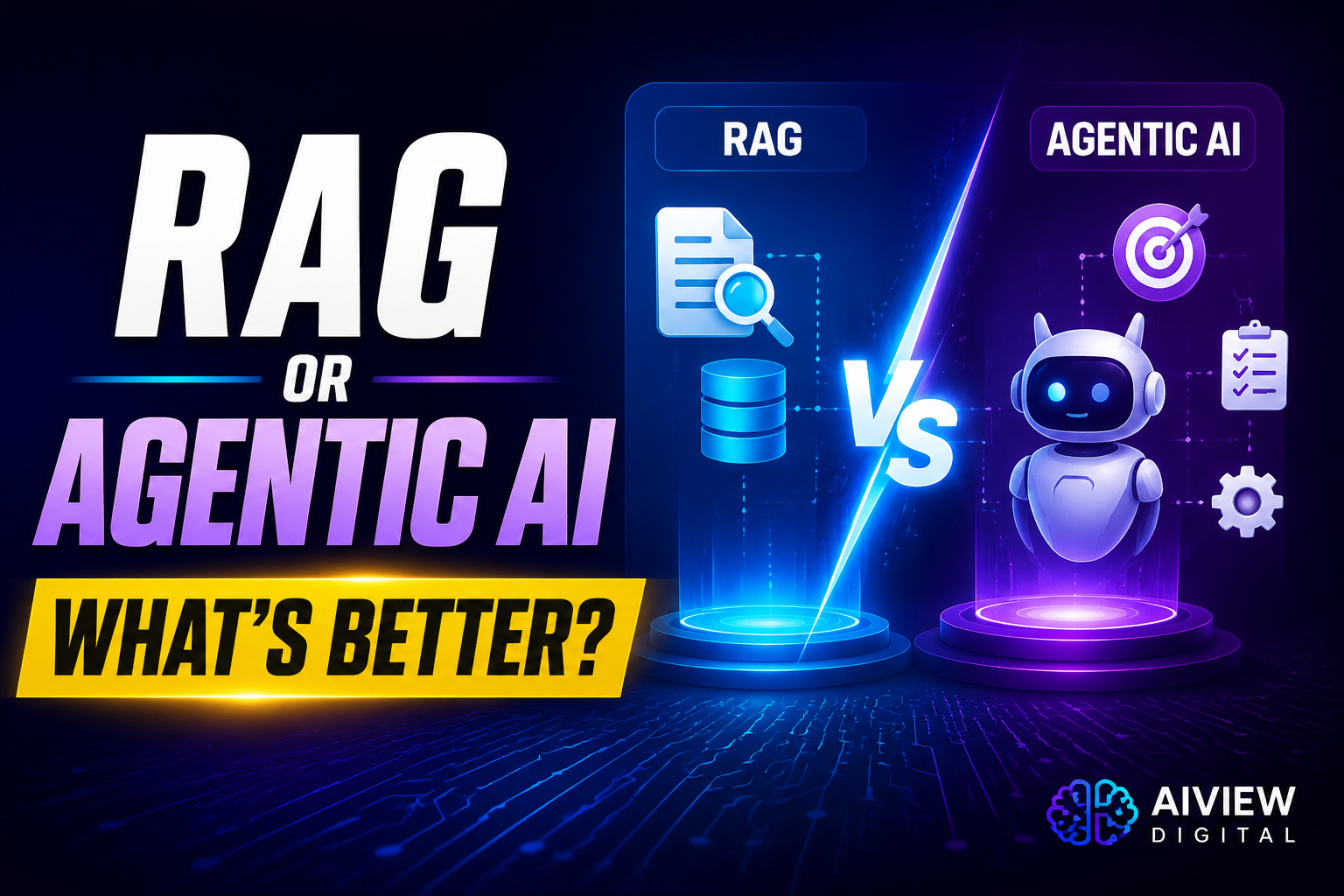
📋 Quick Summary — RAG vs Agentic AI 2026 — Learn and Earn Complete Guide
✅ RAG Systems: ground AI answers in verified business documents
✅ Agentic AI: autonomously executes multi-step workflows end-to-end
✅ Hybrid Approach: combine both for maximum accuracy and automation
✅ Cost Analysis: understand pricing differences before committing budget
✅ Earn: build and sell RAG or Agentic AI solutions to businesses
What is RAG vs Agentic AI? Complete 2026 Overview
Specifically, RAG vs Agentic AI is the defining architectural debate for business AI deployments in 2026. Moreover, understanding this distinction helps companies avoid costly mismatches between technology and business goals.
Moreover, RAG — Retrieval-Augmented Generation — grounds language model responses in real retrieved documents. Furthermore, this approach dramatically reduces hallucinations and keeps answers factually accurate and current.
Furthermore, Agentic AI systems go beyond retrieval by autonomously planning and executing multi-step tasks. Additionally, these agents use tools, APIs, and external services to complete complex goals without human intervention.
Additionally, the 2026 AI landscape has matured enough that businesses can realistically deploy either approach at scale. Consequently, the right choice depends on whether your use case demands accuracy or autonomous action.
Consequently, professionals who master both RAG vs Agentic AI architectures command premium consulting rates globally. Indeed, demand for AI architects who understand both paradigms has tripled since 2024.
Indeed, the RAG vs Agentic AI community is thriving with open-source frameworks, enterprise platforms, and growing ecosystems. Specifically, tools like LangChain, LlamaIndex, AutoGen, and CrewAI serve millions of developers worldwide.
Key Features — RAG vs Agentic AI in 2026
Specifically, the platform provides a complete toolkit for all major professional use cases in 2026.
1. Document Retrieval and Grounding (RAG)
First, RAG systems index your business knowledge base into vector embeddings for semantic search. Additionally, every AI answer is grounded in retrieved source documents, dramatically reducing hallucinations.
Additionally, RAG enables real-time knowledge updates without expensive model fine-tuning cycles. Specifically, new documents added to the index immediately improve answer quality across all queries.
2. Autonomous Multi-Step Execution (Agentic AI)
Moreover, Agentic AI systems decompose complex goals into subtasks and execute them sequentially or in parallel. Specifically, agents can browse the web, write code, send emails, and call APIs autonomously.
Specifically, Agentic AI introduces a planning loop that evaluates progress and adjusts strategy mid-execution. Furthermore, this makes agentic systems ideal for dynamic workflows with unpredictable intermediate steps.
3. Hybrid RAG-Agent Pipelines
Additionally, hybrid architectures let agents retrieve grounded context via RAG before taking autonomous action. Consequently, this combination delivers both factual accuracy and operational autonomy in one unified system.
🎦 Learn RAG vs Agentic AI 2026 — Learn and Earn Complete Guide in 2026 — Video Guides
Furthermore, video learning accelerates mastery of RAG vs Agentic AI dramatically.
Video 1 — RAG vs Agentic AI Explained for Beginners 2025
💡 About: Specifically, this beginner video explains the fundamental difference between RAG and Agentic AI systems. Moreover, it covers how RAG retrieves documents to ground responses in verified data. Furthermore, the video walks through real business use cases for each approach. Additionally, viewers learn which architecture suits simple Q&A versus complex automation workflows. Consequently, beginners gain a clear mental model before choosing their AI deployment strategy.
Video 2 — Building Agentic RAG Pipelines — Advanced Tutorial 2025
🎓 Why: Moreover, this advanced tutorial demonstrates building production-grade Agentic RAG pipelines step by step. Specifically, it covers LangGraph, LlamaIndex, and AutoGen integration patterns for enterprise deployments. Furthermore, the instructor shows how to combine retrieval grounding with autonomous agent loops. Additionally, advanced topics include memory management, tool calling, and multi-agent orchestration at scale. Consequently, developers leave with a working hybrid RAG-Agent system ready for production.
How to Get Started with RAG vs Agentic AI 2026 — Learn and Earn Complete Guide — Step by Step
Moreover, getting started with RAG vs Agentic AI is straightforward following this step-by-step process.
- Step 1 — Assess Your Business Use Case
First, map your core business problem to determine whether accuracy or autonomy matters more. Additionally, document-heavy Q&A workflows favor RAG while complex multi-step processes suit Agentic AI.
- Phase 2 — Choose Your Framework
Additionally, select LlamaIndex or LangChain for RAG, or AutoGen and CrewAI for Agentic AI. Moreover, hybrid needs are best served by LangGraph which supports both retrieval and agent loops natively.
- Action 3 — Build Your Knowledge Base or Agent Tools
Moreover, for RAG ingest your documents into a vector store like Pinecone, Weaviate, or Chroma. Furthermore, for Agentic AI define your tool set including APIs, code executors, and web search capabilities.
- Stage 4 — Test Accuracy and Task Completion
Furthermore, benchmark your RAG system on retrieval precision and answer factuality scores. Consequently, test your Agentic system on task completion rate, loop efficiency, and error recovery behavior.
- Goal 5 — Deploy and Monitor in Production
Finally, deploy your chosen architecture with observability tools like LangSmith or Langfuse for monitoring. Specifically, track latency, cost per query, and hallucination rate to continuously optimize performance.
Mind Map — RAG vs Agentic AI 2026 — Learn and Earn Complete Guide Visual Overview
First, this mind map shows the complete RAG vs Agentic AI ecosystem from core concepts to earning strategies.
Moreover, click any branch to expand it. Furthermore, use the buttons below to navigate.
Additionally, below is a full breakdown organized by category for easy reference.
🗺 RAG vs Agentic AI 2026 — Learn and Earn Complete Guide — Interactive Learning Roadmap
Specifically, this roadmap covers the complete RAG vs Agentic AI mastery path. Moreover, click any node to expand detailed guidance.
RAG vs Agentic AI 2026 — Learn and Earn Complete Guide▶
Furthermore, your starting point: this roadmap covers everything from basic setup through advanced workflows and professional earning strategies in 2026.Foundation
Stage 1 — Basics▶
Foundation: Additionally, start here: understand the core differences between RAG and Agentic AI before building anything.RAG Basics▶
First, learn how Retrieval-Augmented Generation works by combining vector search with language model generation for grounded answers.Vector Stores▶
Specifically, vector stores like Pinecone and Weaviate index document embeddings for fast semantic similarity search.Chunking Strategy▶
Moreover, effective document chunking determines retrieval quality — smaller chunks improve precision while larger chunks improve context.Embedding Models▶
Furthermore, embedding models like text-embedding-3 convert text into dense vectors that enable semantic similarity matching.Retrieval Scoring▶
Additionally, retrieval scoring ranks document chunks by relevance score before passing top results to the language model.
Agentic Basics▶
Moreover, understand how Agentic AI uses planning loops, tool calls, and memory to execute complex multi-step workflows autonomously.Agent Loop▶
Specifically, the agent loop cycles through Observe, Think, Act steps until the goal is fully achieved or aborted.Tool Definitions▶
Furthermore, tools define what actions an agent can take including web search, code execution, and API calls.Planning Module▶
Consequently, planning modules decompose high-level goals into ordered subtasks that the agent executes step by step.Memory Types▶
Additionally, agents use short-term working memory and long-term vector memory to maintain context across extended tasks.
Foundation — Continued
Vector Stores▶
Furthermore, choosing the right vector store impacts retrieval speed, scalability, and cost for your RAG vs Agentic AI deployment.Pinecone▶
Specifically, Pinecone offers managed cloud vector search with millisecond latency and seamless scaling for enterprise RAG systems.Weaviate▶
Moreover, Weaviate provides open-source vector search with built-in hybrid search combining dense and keyword-based retrieval.Chroma▶
Indeed, Chroma is a lightweight local vector store ideal for prototyping RAG systems before scaling to production infrastructure.pgvector▶
Consequently, pgvector adds vector search directly to PostgreSQL enabling RAG without a separate vector database service.
LLM Selection▶
Consequently, the language model you choose affects reasoning quality, cost, and latency for both RAG and Agentic AI systems.GPT-4o▶
Specifically, GPT-4o delivers top-tier reasoning for complex agentic tasks with strong tool-calling capabilities in 2026.Llama 3▶
Furthermore, Llama 3 enables private self-hosted deployments making it ideal for enterprise RAG with sensitive document data.Claude 3.5▶
Moreover, Claude 3.5 Sonnet excels at long-context RAG tasks with its 200K token context window for large documents.Gemini 1.5▶
Additionally, Gemini 1.5 Pro offers multimodal RAG support enabling retrieval across text, images, and video content.
Key Features
Stage 2 — Build Skills▶
Key Features: Furthermore, go deeper: master retrieval tuning, agent tool design, and grounding evaluation techniques for production systems.Retrieval▶
Moreover, advanced retrieval techniques like hybrid search and reranking dramatically improve RAG system answer quality and precision.Hybrid Search▶
Additionally, hybrid search combines dense vector similarity with keyword BM25 scoring for more robust document retrieval results.Reranking▶
Consequently, reranker models like Cohere Rerank score retrieved chunks a second time to surface the most relevant passages.Multi-Query▶
Specifically, multi-query retrieval generates multiple reformulations of the user question to retrieve more comprehensive document coverage.HyDE▶
Furthermore, Hypothetical Document Embedding generates a fake answer first then retrieves real documents similar to that hypothesis.
Grounding▶
Specifically, grounding techniques ensure language model answers stay faithful to retrieved evidence rather than generating unsupported claims.Citation Tracking▶
Moreover, citation tracking links each sentence in the AI answer back to the specific source document and page number.Faithfulness Check▶
Additionally, faithfulness evaluation frameworks like RAGAS score whether answers are supported by retrieved context passages.Source Attribution▶
Consequently, source attribution shows users exactly which documents informed each answer improving trust and verifiability.Confidence Scoring▶
Specifically, confidence scores estimate how well retrieved documents actually answer the question before generating a response.
Key Features — Continued
Planning▶
Additionally, agent planning strategies determine how well Agentic AI systems decompose and complete complex multi-step business tasks.ReAct Pattern▶
Furthermore, the ReAct pattern interleaves reasoning steps with action execution enabling agents to adapt based on intermediate results.Tree of Thought▶
Specifically, Tree of Thought planning lets agents explore multiple solution paths simultaneously and select the most promising branch.Plan and Execute▶
Moreover, Plan-and-Execute agents create a full plan upfront then execute each step with a separate execution module.Reflexion▶
Consequently, Reflexion agents evaluate their own outputs and retry failed steps with improved strategies for higher success rates.
Tool Calling▶
Consequently, tool calling capabilities define what Agentic AI systems can actually do in the real world for businesses.Web Search▶
Specifically, web search tools give agents access to real-time information beyond their training data cutoff for current tasks.Code Execution▶
Additionally, code execution tools let agents write and run Python scripts for data analysis, math, and file processing tasks.API Calls▶
Furthermore, API calling enables agents to interact with CRMs, databases, payment systems, and third-party business services.File I/O▶
Moreover, file input-output tools allow agents to read, write, and transform documents, spreadsheets, and data files autonomously.
Use Cases
Stage 3 — Apply to Business▶
Use Cases: Consequently, master this: map RAG vs Agentic AI to specific high-value business use cases for maximum ROI.Customer Support▶
Furthermore, customer support is the most common RAG deployment — grounding AI chatbots in product documentation and knowledge bases.FAQ Automation▶
Specifically, RAG automates FAQ responses by retrieving the most relevant support articles for each incoming customer question.Ticket Resolution▶
Moreover, Agentic AI resolves support tickets by autonomously searching systems, applying fixes, and updating CRM records.Escalation Logic▶
Additionally, agentic systems decide when to escalate issues to human agents based on sentiment and complexity analysis.CSAT Analysis▶
Consequently, RAG-powered analysis of customer feedback identifies satisfaction trends from support transcripts and survey responses.
Code Generation▶
Specifically, Agentic AI excels at code generation tasks by writing, testing, and debugging software autonomously within pipelines.Code Synthesis▶
Furthermore, agentic code synthesis generates complete functions, classes, and modules from natural language specifications and examples.Auto Testing▶
Moreover, agents automatically write unit tests, run them, and fix failures in an iterative test-driven development loop.Code Review▶
Additionally, RAG-enhanced code review retrieves relevant coding standards and past patterns to ground review suggestions.Dependency Management▶
Specifically, agentic systems scan codebases, identify outdated dependencies, and automatically create pull requests with updates.
Use Cases — Continued
Data Analysis▶
Additionally, both RAG and Agentic AI enhance data analysis — RAG grounds insights in documents while agents execute analytical tasks.Report Generation▶
Moreover, RAG generates grounded business reports by retrieving relevant data points from internal documents and databases.SQL Generation▶
Furthermore, Agentic AI writes and executes SQL queries autonomously to answer natural language questions about databases.Dashboard Insights▶
Specifically, RAG-powered dashboards surface contextual insights by retrieving relevant metrics and explaining them in plain language.Anomaly Detection▶
Consequently, agents monitor data streams, detect anomalies, and autonomously trigger alerts or corrective workflows in real time.
Research Automation▶
Consequently, research automation is where Agentic AI shines — autonomously gathering, synthesizing, and reporting on complex topics.Web Research▶
Specifically, research agents browse multiple websites, extract key information, and synthesize findings into structured reports.Document Synthesis▶
Moreover, RAG enables synthesis across hundreds of internal documents to answer complex multi-document research questions accurately.Competitive Intel▶
Additionally, agentic systems continuously monitor competitor websites and news sources to deliver competitive intelligence reports.Literature Review▶
Furthermore, RAG-powered literature review retrieves and summarizes relevant academic papers to support research and decision making.
Integrations
Stage 4 — Connect Tools▶
Integrations: Finally, earn with this: integrate RAG and Agentic AI with leading frameworks to build powerful deployable business solutions.LangChain▶
Subsequently, LangChain provides the most comprehensive toolkit for building both RAG pipelines and Agentic AI systems in Python.LangGraph▶
Also, LangGraph extends LangChain with stateful graph-based agent orchestration enabling complex multi-agent workflow management.LangSmith▶
Therefore, LangSmith provides observability and evaluation for LangChain RAG and agent deployments with trace visualization.LangServe▶
Specifically, LangServe deploys LangChain RAG and agent chains as REST APIs with automatic FastAPI endpoint generation.LCEL▶
Moreover, LangChain Expression Language creates composable declarative pipelines connecting retrievers, LLMs, and output parsers.
LlamaIndex▶
Moreover, LlamaIndex specializes in data ingestion and RAG pipeline construction with advanced indexing and retrieval strategies.Data Connectors▶
Additionally, LlamaIndex data connectors ingest from 100+ sources including Notion, Google Drive, Confluence, and databases.Query Engine▶
Consequently, LlamaIndex query engines support sub-question decomposition, routing, and hybrid retrieval for complex RAG queries.Agentic RAG▶
Specifically, LlamaIndex Agentic RAG combines retrieval tools with agent loops for dynamic context-aware task execution.Evaluation Suite▶
Furthermore, LlamaIndex evaluation measures retrieval precision, answer faithfulness, and context relevance for production RAG systems.
Integrations — Continued
AutoGen▶
Furthermore, AutoGen by Microsoft enables multi-agent conversation frameworks where specialized agents collaborate on complex tasks.Multi-Agent Chat▶
Specifically, AutoGen orchestrates conversations between user proxies, assistants, and specialized agents to complete complex workflows.Code Agents▶
Moreover, AutoGen code execution agents write Python and run it in sandboxed Docker environments for safe automation tasks.Agent Customization▶
Additionally, AutoGen allows deep customization of agent personas, system prompts, and termination conditions for specific workflows.Group Chat▶
Consequently, AutoGen GroupChat enables multiple specialized agents to collaborate through structured dialogue toward shared objectives.
CrewAI▶
Consequently, CrewAI provides a high-level framework for building collaborative multi-agent systems with role-based task delegation.Agent Roles▶
Specifically, CrewAI defines agent roles like Researcher, Writer, and Analyst with specific goals and tool access configurations.Task Assignment▶
Moreover, CrewAI tasks define expected outputs and dependencies enabling structured sequential or parallel agent execution flows.Process Types▶
Additionally, CrewAI supports sequential and hierarchical process types matching different multi-agent workflow orchestration needs.Tool Integration▶
Furthermore, CrewAI integrates with LangChain tools giving agents access to search, APIs, and custom business tool definitions.
Earning Strategies
Stage 5 — Monetize▶
Earning Strategies: Specifically, monetize your RAG vs Agentic AI expertise through consulting, SaaS products, freelancing, and educational content creation.AI Consulting▶
Moreover, AI consulting is the fastest path to high income — businesses pay premium rates for RAG and Agentic AI architecture guidance.Architecture Audits▶
Furthermore, architecture audits assess existing AI systems and recommend RAG or Agentic AI improvements for $5K–$20K per engagement.POC Development▶
Specifically, proof-of-concept development builds initial RAG or agent prototypes for clients at $3K–$10K fixed-price contracts.Team Training▶
Additionally, training enterprise development teams on RAG and Agentic AI implementation commands $2K–$5K per training day.Ongoing Retainers▶
Consequently, monthly retainer contracts for AI system maintenance and optimization generate $5K–$15K recurring monthly income.
SaaS Products▶
Furthermore, building SaaS products on top of RAG or Agentic AI frameworks creates scalable recurring revenue streams for developers.RAG SaaS▶
Specifically, RAG-as-a-Service platforms let businesses upload documents and query them via API at $99–$999 per month.Agent Platforms▶
Moreover, no-code Agentic AI platforms targeting non-technical users command $49–$299 monthly subscription pricing per seat.Vertical SaaS▶
Additionally, vertical-specific AI tools for legal, medical, or finance using RAG achieve premium pricing of $500–$5K monthly.API Products▶
Consequently, selling RAG or agent capabilities as API endpoints with usage-based pricing scales revenue with customer adoption.
Earning Strategies — Continued
Freelance Builds▶
Additionally, freelance project work building RAG and Agentic AI systems for clients provides immediate income while building your portfolio.Upwork Projects▶
Specifically, RAG chatbot projects on Upwork pay $2K–$15K with senior AI developers earning $100–$200 per hour.Direct Clients▶
Moreover, direct client relationships bypass platform fees enabling $5K–$50K project contracts for complex agentic systems.Templates▶
Furthermore, selling reusable RAG and agent templates on Gumroad or GitHub Sponsors earns $500–$5K per template product.Niche Specialization▶
Additionally, specializing in one vertical like healthcare RAG or legal agents commands higher rates and referral-based client flow.
Training Courses▶
Consequently, creating educational content about RAG vs Agentic AI generates passive income as demand for AI skills keeps growing.Udemy Courses▶
Specifically, Udemy courses on RAG and Agentic AI with 5+ hours of content earn $2K–$10K monthly in passive royalties.Newsletter▶
Moreover, paid newsletters covering RAG vs Agentic AI news and tutorials charge $10–$30 monthly reaching thousands of subscribers.YouTube Channel▶
Additionally, YouTube channels teaching RAG and agent implementation earn $3K–$20K monthly through ads and sponsorships.Cohort Programs▶
Furthermore, live cohort-based courses on building production RAG and agent systems charge $500–$2K per student per cohort.
Advanced
Stage 6 — Expert Level▶
Advanced: Consequently, master advanced RAG vs Agentic AI topics including hybrid pipelines, fine-tuning, observability, and multi-agent coordination.Hybrid Pipelines▶
Furthermore, hybrid RAG-Agent pipelines represent the state-of-the-art combining retrieval grounding with autonomous execution for maximum capability.Agentic RAG▶
Specifically, Agentic RAG lets agents decide when and what to retrieve dynamically based on reasoning rather than fixed retrieval.Multi-Source RAG▶
Moreover, multi-source RAG retrieves from databases, APIs, and vector stores simultaneously then merges results for comprehensive answers.Adaptive Retrieval▶
Additionally, adaptive retrieval adjusts chunking size and search strategy based on query complexity for optimal retrieval performance.Agent-Directed RAG▶
Consequently, agent-directed RAG uses the planning module to decompose queries before issuing targeted sub-queries to the retriever.
Multi-Agent▶
Specifically, multi-agent systems distribute complex tasks across specialized agents enabling parallelism and expert role separation at scale.Supervisor Agents▶
Furthermore, supervisor agents orchestrate worker agents by assigning subtasks and aggregating results into cohesive final outputs.Parallel Execution▶
Moreover, parallel agent execution reduces task completion time by running independent subtasks simultaneously across multiple agents.Agent Guardrails▶
Additionally, guardrails prevent agents from taking harmful or unauthorized actions by validating planned steps before execution.Agent Evaluation▶
Specifically, evaluating multi-agent systems requires measuring both individual agent performance and overall system task completion rates.
Advanced — Continued
Fine-Tuning▶
Additionally, fine-tuning LLMs on domain-specific data improves both RAG grounding quality and Agentic AI task accuracy significantly.LoRA Fine-Tuning▶
Moreover, LoRA fine-tuning trains domain-specific adaptations of large models efficiently using low-rank weight matrix updates.RLHF for Agents▶
Furthermore, reinforcement learning from human feedback trains agents to complete business tasks more reliably and safely over time.Synthetic Data▶
Specifically, synthetic data generation creates training examples for rare RAG queries or complex agent task scenarios automatically.Domain Adaptation▶
Consequently, domain-adapted models outperform general models on specialized RAG and agent tasks in legal, medical, and finance.
Observability▶
Consequently, production RAG and Agentic AI systems require comprehensive observability to monitor quality, cost, and performance at scale.LangSmith▶
Specifically, LangSmith traces every RAG retrieval and agent action step enabling root cause analysis for quality issues.Langfuse▶
Moreover, Langfuse provides open-source LLM observability with cost tracking, latency monitoring, and prompt version management.RAGAS Eval▶
Additionally, RAGAS evaluates RAG systems on faithfulness, answer relevance, and context precision with automated scoring pipelines.Arize AI▶
Furthermore, Arize AI monitors production AI models for drift, hallucination rates, and performance degradation over time.
How to Earn Money with RAG vs Agentic AI in 2026
Specifically, RAG vs Agentic AI skills command premium rates as businesses urgently seek architects who understand both paradigms. Moreover, consultants specializing in this space earn $150–$300 per hour with enterprise clients paying $20K–$100K per project.
Moreover, the market for AI implementation services is growing at 38% annually with no sign of slowing in 2026. Consequently, professionals who can deploy both RAG and Agentic AI systems are among the highest-paid technical specialists globally.
For instance, building custom RAG systems for enterprise clients earns $5K–$30K per project engagement. Additionally, recurring maintenance retainers add $3K–$8K monthly in predictable revenue on top of project fees.
Additionally, building Agentic AI workflows for business process automation commands $10K–$50K per custom implementation. Furthermore, complex multi-agent systems for Fortune 500 companies regularly exceed $100K in total project value.
Furthermore, creating courses teaching RAG vs Agentic AI implementation generates $3K–$15K monthly in passive income. Importantly, Udemy and Teachable platforms provide immediate access to millions of motivated learners globally.
More Ways to Earn with RAG vs Agentic AI in 2026
Also, launching a niche RAG or Agentic AI SaaS product earns $5K–$50K monthly in recurring subscription revenue. Particularly, vertical-specific tools targeting legal, medical, or finance sectors command premium subscription pricing from businesses.
Specifically, senior RAG and Agentic AI developers on Upwork earn $100–$200 per hour with consistent project availability. Consequently, building a strong portfolio of RAG chatbot and agent projects accelerates client acquisition and rate growth.
Consequently, YouTube channels teaching RAG vs Agentic AI concepts attract sponsorships from AI tool companies paying $2K–$10K per video. Moreover, pairing a monetized YouTube channel with a paid newsletter creates a $10K–$30K monthly content business.
💡 Pro Tip: Additionally, combine RAG vs Agentic AI with n8n automation. Furthermore, visit the Prompt Engineer guide.
RAG vs Agentic AI 2026 — Full Comparison Table
Moreover, comparing RAG vs Agentic AI against hybrid and alternative approaches helps you choose the right architecture for your business needs.
| Feature | RAG Systems | Agentic AI | Hybrid RAG-Agent | Fine-Tuned LLM |
|---|---|---|---|---|
| Factual Accuracy | ✅ Excellent | ⚡ Moderate | ✅ Excellent | ⚡ Variable |
| Autonomous Action | ❌ No | ✅ Full | ✅ Full | ❌ No |
| Real-Time Data | ✅ Yes | ✅ Yes | ✅ Yes | ❌ No |
| Setup Complexity | ⚡ Medium | ⚡ High | ⚡ High | ✅ Low |
| Cost per Query | ⚡ Medium | ⚡ High | ⚡ High | ✅ Low |
| Best For | Q&A, Support | Automation | Complex Tasks | Domain Specific |
| Free Tier Available | ✅ Yes | ✅ Yes | ⚡ Limited | ❌ No |
| Starting Price | Free | Free | $20/mo | $50/mo |
What Makes RAG vs Agentic AI the Best Choice Framework in 2026
Specifically, understanding RAG vs Agentic AI gives businesses a clear framework for matching AI architecture to actual use cases.
Additionally, RAG delivers unmatched factual accuracy by grounding every answer in verified retrieved documents from your knowledge base.
Furthermore, Agentic AI provides autonomous execution capability that no retrieval-only system can match for complex workflows.
Moreover, the hybrid approach combining both RAG and Agentic AI represents the most powerful and flexible architecture available in 2026.
Consequently, mastering both paradigms positions professionals and businesses at the absolute frontier of practical AI deployment.
RAG vs Agentic AI for Business Leaders in 2026
Indeed, business leaders choosing between RAG vs Agentic AI must align their selection with core operational priorities. Specifically, companies where accuracy and compliance matter most — like legal and healthcare — should default to RAG architectures first.
Specifically, Agentic AI becomes the right choice when businesses need to automate complex multi-step workflows without human intervention. Moreover, operations teams benefit most from agentic systems that can autonomously execute tasks across multiple software systems.
Moreover, the total cost of ownership differs significantly between RAG vs Agentic AI deployments at enterprise scale. Furthermore, RAG systems have more predictable costs while agentic systems incur higher token costs due to longer reasoning loops.
Furthermore, business leaders should pilot both approaches before committing to a single architecture for production deployment. Consequently, running parallel RAG and Agentic AI pilots on real use cases provides the most reliable data for final architecture decisions.
How to Use RAG vs Agentic AI with Other AI Tools
Additionally, RAG vs Agentic AI systems work best when integrated with broader AI tool ecosystems including vector databases and LLM APIs. Specifically, combining LlamaIndex for RAG with CrewAI for agents creates powerful hybrid systems serving diverse business needs.
Specifically, combining RAG with n8n workflow automation enables document-grounded AI answers triggered by business events automatically. Moreover, this integration reduces manual work while ensuring AI responses remain grounded in verified company knowledge.
Moreover, pairing Agentic AI with observability tools like LangSmith enables production-grade monitoring of autonomous agent behavior. Consequently, teams can detect when agents fail, hallucinate, or take unexpected actions before they impact business operations.
Consequently, users who combine RAG for knowledge retrieval with Agentic AI for task execution unlock the full potential of AI automation. Additionally, this hybrid approach delivers both the accuracy of retrieval grounding and the power of autonomous multi-step execution.
Common Questions About RAG vs Agentic AI in 2026
Specifically, most beginners have these core questions about RAG vs Agentic AI before choosing their business AI architecture.
Do You Need to Code to Use RAG vs Agentic AI?
Specifically, basic RAG deployments are accessible to non-coders using no-code tools like Flowise, Dify, and Botpress platforms. Additionally, these platforms provide visual pipeline builders that hide the underlying vector store and LLM complexity from users.
Additionally, Agentic AI platforms like Voiceflow and Make.com enable no-code agent building for common business automation use cases. Moreover, technical users who learn Python unlock far more powerful and customizable RAG and agent systems using LangChain or LlamaIndex.
What Is the Difference Between RAG vs Agentic AI and Fine-Tuning?
Specifically, RAG retrieves external documents at inference time while fine-tuning bakes knowledge into model weights at training time. Moreover, RAG is preferred for dynamic knowledge that changes frequently while fine-tuning suits stable domain style adaptation.
Moreover, Agentic AI differs from both by focusing on autonomous action execution rather than knowledge retrieval or model training. Specifically, the right approach depends entirely on whether your business needs accuracy, autonomy, or domain-specific language style.
Realistic Income Timeline for RAG vs Agentic AI Beginners
First, in month one, beginners should complete a RAG fundamentals course and build their first chatbot using LlamaIndex or LangChain. Additionally, deploying a simple document Q&A system on a free tier establishes a foundational portfolio piece for client outreach.
Then, in month two, focus on building an Agentic AI prototype using AutoGen or CrewAI to demonstrate autonomous task capabilities. Moreover, documenting both projects publicly on GitHub and LinkedIn attracts early freelance inquiries from businesses exploring AI solutions.
Moreover, by month three, combining RAG and Agentic AI skills enables pitching hybrid AI solutions to small business clients. Furthermore, first consulting projects in the $2K–$5K range become realistic for developers with a strong documented portfolio.
Consequently, by month six, consistent client delivery and referrals enable scaling to $8K–$20K monthly in consulting and freelance revenue. Therefore, starting your RAG vs Agentic AI learning journey today positions you for significant income growth within six months.
Save This RAG vs Agentic AI 2026 — Learn and Earn Complete Guide Guide for Later
Additionally, pin this 2026 guide to your Pinterest board for easy reference.
📌 Save to Pinterest📊 More Questions About RAG vs Agentic AI 2026 — Learn and Earn Complete Guide
More Questions — Continued
Therefore, RAG vs Agentic AI is one of the most powerful platforms for professionals in 2026.
Start Learning RAG vs Agentic AI and Earning in 2026 Today
In conclusion, this guide covers everything for RAG vs Agentic AI decision-making and implementation in 2026. Therefore, whether you need factual grounding with RAG or autonomous execution with Agentic AI, the path forward is clear. Furthermore, the best time to build your RAG vs Agentic AI expertise and start earning is right now.
🚀 Start with LlamaIndex FreeDiscover more from SoftHubTools
Subscribe to get the latest posts sent to your email.


[…] RAG vs Agentic AI 2026 — Learn and Earn Complete Guide […]
[…] RAG vs Agentic AI 2026 — Learn and Earn Complete Guide […]